The energy transition is becoming increasingly digital, decentralized, and complex. For municipal utilities, this means that it is no longer enough to simply introduce individual technologies. What matters most is how metering systems, IT, hardware, market processes, and operational workflows are integrated into a functioning overall system.
René Böringer, co-founder and CEO of Cuculus GmbH, and Aurelius Wosylus, managing director of neugemacht GmbH, have already discussed this very topic in the “Future of Energy” publication. In that publication, René Böringer describes a highly fragmented market in which municipal utilities must work with a multitude of specialized IT providers and standalone solutions. Aurelius Wosylus contrasts this with an end-to-end implementation chain—from quotation through ordering, delivery, and installation all the way to operation, data visualization, and billing.
The key question, therefore, is not only what technology is needed, but above all: How can it be reliably integrated into existing operations?
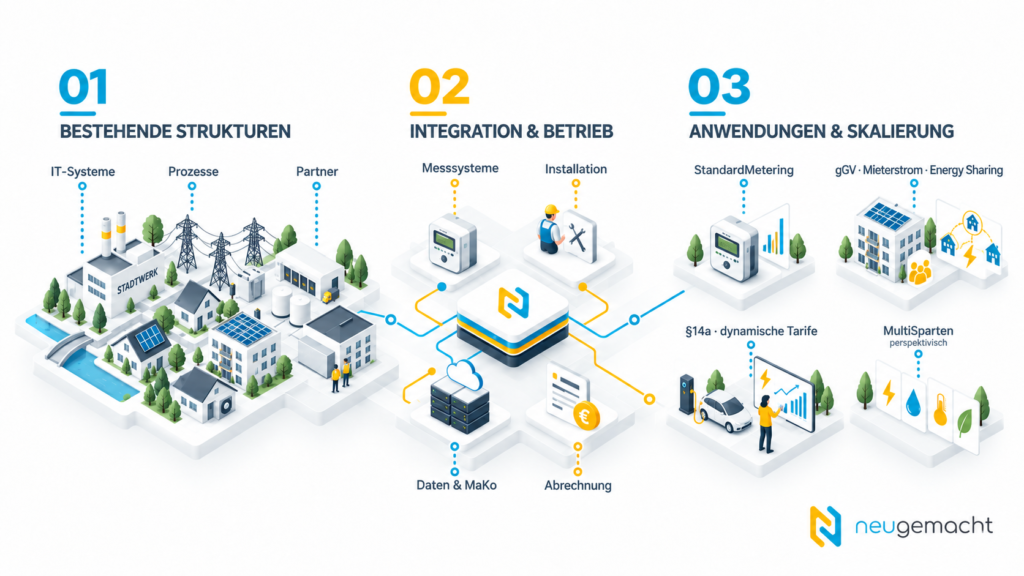
Continue to Utilize Existing Structures
For many municipal utilities, a complete overhaul is neither necessary nor realistic. Existing IT systems, processes, employees, and partner structures have evolved over the years and fulfill important operational functions.
A practical approach should therefore not aim to completely replace existing structures. Rather, the goal is to add new components where they are actually needed and to integrate them seamlessly into the existing system landscape.
This applies to software, hardware, and operational services alike. New meters, gateways, control technology, and energy management systems can only realize their full potential when installation, data communication, market processes, billing, and day-to-day operations are also functioning properly.
That is why small and medium-sized municipal utilities in particular benefit from a modular approach: start with a specific project, gain experience, and then gradually expand the solution.
End-to-End Means More Than Just a Technical Platform
The term “end-to-end” is frequently used in the energy market. In practice, however, a central platform alone is not enough.
A project must function effectively throughout the entire operational chain: from planning and quoting, through component ordering, logistics, and installation, to commissioning. This is followed by data processing, market communication, visualization, billing, and ongoing operations.
It is precisely at these points of transition that additional interfaces and responsibilities often arise. The more different systems, manufacturers, and service providers are involved, the more important clear coordination becomes.
A scalable operating model must therefore not only be technically open; it must also reflect the organizational and operational processes behind it.
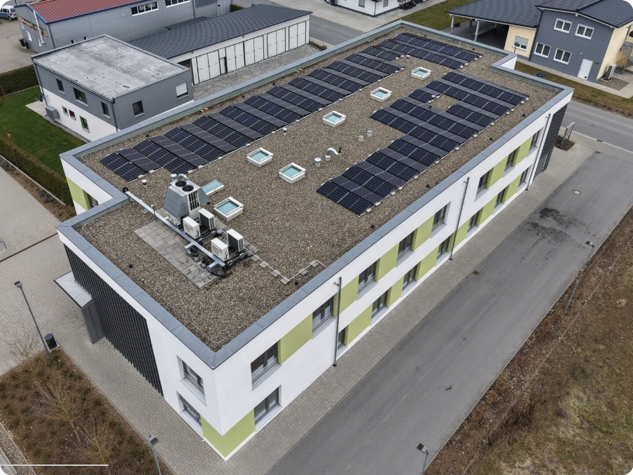
Stuttgart-Vaihingen: gGV in Real-World Operation
The project demonstrates how shared building services (gGV) can be implemented in practice, even under complex conditions.
This involves integrating various technical and energy-related components into a unified measurement and operational concept.
Among other things, the following are used:
- a photovoltaic system,
- an energy storage system,
- a central heat pump,
- Charging infrastructure at the parking spaces,
- the integration of a home energy management system,
- virtual counters,
- A dynamic gGV distribution key.
neugemacht does not merely handle technical tasks here. The project also included rollout and on-site installation, as well as operations as a competitive metering point operator. Additionally, the standard 15-minute readings from the virtually generated meters are communicated to the market via Mako.
The redesigned Energy Portal provides both operators and end customers with a wider range of digital features. These include, among other things, contract management, tenant change processes, customized gGV pricing options, and automated invoice generation and delivery.
This illustrates what “end-to-end” means in practice: The focus is not on a single technology, but rather on the effective interplay of measurement, control, data, market processes, and billing.
From a Single Project to a Scalable Structure
A single building is not the ultimate goal, but it can be a sensible starting point.
Municipal utilities can initially test complex new applications in a manageable project. This allows them to evaluate technical interfaces, operational processes, and responsibilities in a real-world setting before proceeding with larger rollouts.
This phased approach is particularly relevant for applications such as gGV, tenant electricity, energy sharing, or controllable consumption devices. This is because with each new application, not only does the technical complexity increase, but so does the number of market roles and processes involved.
The challenge, therefore, lies less in introducing as many new systems as possible. What matters most is establishing a structure that can be expanded.
Implementation Is Becoming the Decisive Factor
The technologies for many applications of the energy transition are already available. The real challenge is increasingly shifting from technical feasibility to operational implementation.
For municipal utilities, this means that new business models must be able to integrate into existing system environments, work with existing partners, and remain manageable in day-to-day operations.
This is precisely where the value of a modular end-to-end approach lies. It makes it possible to continue using existing structures, add new components in a targeted manner, and start with specific applications.
This is how a concept becomes a functioning business—and how a single project becomes the foundation for further applications.
This article is based on an interview with René Böringer and Aurelius Wosylus featured in the 2026 “Future of Energy” publication.
Media Contact
, neugemacht GmbH
marketing@neugemacht.com